BatteriesMarch 2026·8 min read
Can a Home Battery Actually Make You Money?
Real numbers on payback periods, arbitrage potential and the conditions under which home batteries make genuine financial sense.
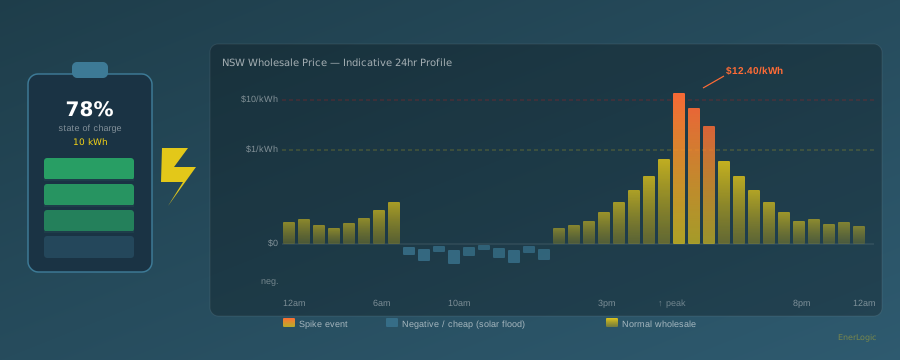
The standard payback period conversation misses the real question: when and under what conditions can a home battery actually generate income? We used NSW wholesale price data from 2020–2025 to find out.
The Opportunity: Wholesale Price Spikes
Two price thresholds matter for battery arbitrage economics:
- ≥ $1.00/kWh — materially better than standard feed-in tariffs (typically 5–10c/kWh)
- ≥ $10.00/kWh — battery exporting at rated capacity can earn $50–$150+ in a single five-minute dispatch interval
| Year | Spike events (≥$1/kWh) | Spike events (≥$10/kWh) | Annual avg price | Context |
|---|---|---|---|---|
| 2021 | ~80–130 | ~8–15 | ~$280/MWh | Gas/coal crisis, administered prices |
| 2023 | ~180–240 | ~12–22 | ~$105/MWh | Mild year |
| 2024 | ~300–400 | ~45–70 | ~$150/MWh | May administered prices |
| 2025 | ~200–300 | ~20–40 | ~$90/MWh est. | New battery storage suppressed volatility |
Six Constraints Determine Real Returns
- Self-consumption load — overnight household use depletes the battery before evening price peaks
- Phase configuration — single phase caps export at 5–10 kW; three phase allows up to 30 kW
- Inverter continuous discharge rate — use the datasheet continuous figure, not the peak rating
- Battery C-rate — determines how much energy is deliverable per hour relative to capacity
- Tariff structure — wholesale pass-through tariffs (Amber, LocalVolts) are required for spike participation
- State of charge timing — the battery must be full before a spike arrives
Four Scenarios Compared
| Scenario | System | Phase | Battery size | Savings/yr | Spike revenue | Total |
|---|---|---|---|---|---|---|
| A | 10 kW / 16 kWh | 1PH | 23 kWh | $2,200 | $640 | $3,740 |
| B | 10 kW / 16 kWh | 3PH | 23 kWh | $2,840 | $1,500 | $4,940 |
| C | 15 kW / 24 kWh | 1PH | 30 kWh | $3,840 | $540 | $5,220 |
| D | 15 kW / 24 kWh | 3PH | 30 kWh | $3,840 | $1,620 | $6,220 |
The Verdict
Three-phase connections and wholesale pass-through tariffs are the two biggest levers on battery income. Without them, arbitrage revenue is limited but still positive. A properly configured system in the right household can genuinely earn, not just save.