Nuclear Power in Australia: Is It All Just Hot Steam?
Supporters cite firm, 24/7, low-emissions electricity. Critics flag construction timelines, cost overruns and water use. The numbers are less ambiguous than the politics.
Supporters cite firm, 24/7, low-emissions electricity. Critics flag construction timelines, cost overruns and water use. The numbers are less ambiguous than the politics.
Australia's 2025 Energy Context
Australia generates roughly 280–285 TWh annually. Renewables now exceed 40% nationally and are growing rapidly. Electricity demand is forecast to roughly double by 2050 as transport, space heating and industrial processes electrify.
Nuclear's Genuine Advantages
- High capacity factors — nuclear runs at 90%+ utilisation, unlike intermittent wind and solar
- Low operational emissions — comparable lifecycle emissions per kWh to onshore wind
- Small land footprint — enormous energy density relative to surface area
- Grid inertia and system strength — synchronous generation provides inherent stability
The Challenges Facing Nuclear in Australia
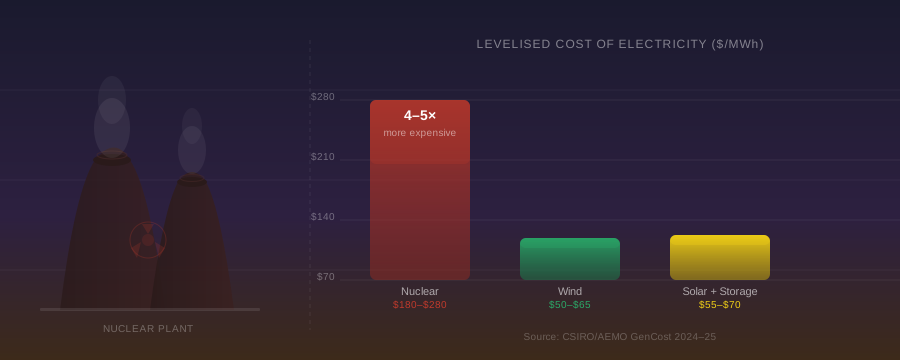
CSIRO and AEMO's GenCost modelling consistently shows utility-scale solar and wind are the cheapest new electricity sources available to Australia — by a wide margin. New nuclear in Australia is estimated at $180–$280/MWh levelised cost, versus $40–$65/MWh for new-build wind and solar with storage.
New nuclear plants require 15–20+ years to build from policy decision to first electricity. Australia's remaining coal fleet will retire well before then — the grid needs solutions deployable in the 2020s, not the 2040s.
Australia currently prohibits nuclear power under federal law. Any pathway requires legislative change, a new regulatory framework, workforce development and site selection — each adding years before construction can begin.
Australia's Renewable Advantage
Australia has among the best renewable energy resources on the planet — abundant solar irradiance across most of the continent, strong coastal wind resources and growing offshore wind potential. These resources cost far less than nuclear and can be deployed in 2–5 years per project rather than 15–20.
Nuclear is most cost-competitive in countries with poor renewable resources. Australia has among the best renewable resources on the planet.
The Verdict
Nuclear is not the most sensible primary investment for Australia today. The timeline, cost and delivery risk make it a poor substitute for deployable renewables and storage. It could become relevant if the renewable rollout stalls badly and long-duration storage fails to mature at scale — but banking on those outcomes is itself a significant risk.