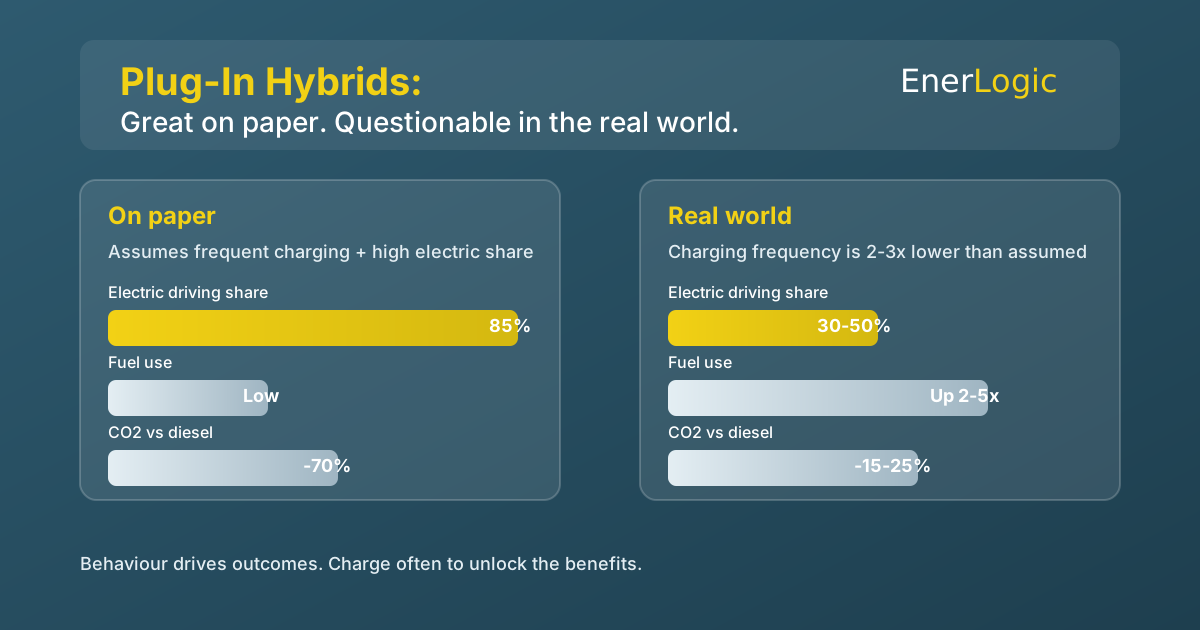
Plug-in Hybrids: Great on Paper, Questionable in the Real World
The PHEV pitch works if users behave optimally. Most don't — and the emissions data shows it.
"Electric when you want it, petrol when you need it." The plug-in hybrid pitch is compelling. But PHEVs only function as advertised if users consistently charge, consistently choose electric mode and consistently make the behavioural choices the brochure assumes.
The Energy Physics
Diesel holds ~10 kWh/litre chemically, but internal combustion engines convert only 25–30% of that into forward motion. You get roughly 2.5–3 kWh of wheel-work per litre.
Battery electric vehicles convert ~85–90% of electrical energy into motion. The consequence: every accessory load — hills, air conditioning, headwinds — is visible in EV range prediction. In a petrol car, those same loads vanish into baseline combustion losses.
The Structural Problem with PHEVs
A PHEV carries the full mechanical complexity of both an ICE drivetrain and an EV drivetrain — two engines, two fuel systems, double the maintenance surface area, and a battery too small for meaningful all-electric daily range in most real-world use cases.
PHEVs are conditionally clean, not automatically clean. The emissions outcome depends on user behaviour, not engineering.
Lifetime Emissions Comparison
| Vehicle type | Estimated lifetime emissions (15 yr, ~200,000 km) |
|---|---|
| PHEV — optimal user (charges daily) | 27.5 t CO₂e |
| PHEV — average user (charges 3–4×/week) | 37.5 t CO₂e |
| PHEV — convenience wins (rarely charges) | 39.5 t CO₂e |
| Full BEV (Australian grid, improving over time) | 19.5 t CO₂e |
Average low-engagement PHEV users drift close to diesel outcomes despite paying a significant purchase premium for the hybrid system.
The Grid Emissions Argument
The 'but the grid is dirty' counter-argument weakens every year. Australia's grid decarbonises over time while combustion engines do not. An EV purchased today will run on progressively cleaner electricity for its entire 15+ year lifespan. A PHEV purchased today still burns petrol in 2040.
The Verdict
PHEVs aren't dismissed outright — the perfect PHEV user achieves near-BEV outcomes. But at scale, policy cannot rely on optimal user behaviour. For genuine emissions reduction, a full BEV beats a hybrid without depending on human discipline.