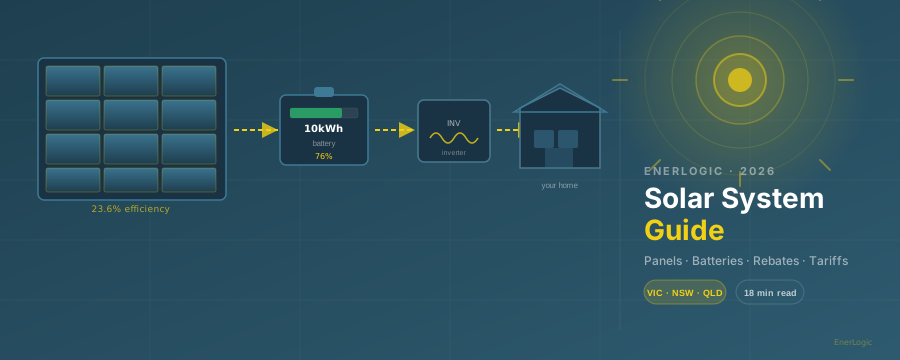
EnerLogic Solar System Guide 2026
Everything you need to choose the right solar panels, battery, inverter and tariff plan for an Australian home in 2026.
This guide covers everything you need to make an informed decision about solar panels, batteries, inverters and tariff plans for Australian homes in 2026. We've compared brands, modelled real-world economics and distilled it into clear recommendations.
01 — Solar Panels
We compared five leading brands at 475 W (TCL 440 W). Efficiency ranges from 21.5% (TCL) to 23.6% (Aiko). Wholesale prices span $105–$141 per panel.
Over 15 years, Aiko produces roughly $3,900 more value than TCL, yet costs only ~$490 more per system — making the premium payback very fast. N-Type cells are preferred for both product warranty (10–25 yr) and performance warranty (80–90% at 25 yr).
Panels available in 20+ years will be a completely different form factor, cell technology and output profile. Don't let warranty length alone drive the decision.
02 — System Sizing
Average Australian households use 15–25 kWh/day. Recommended system sizes range from 5 kW (small household, no EV) to 13.2 kW (large home with EV). The right size depends entirely on your 30-minute interval data.
Key principle: prioritise self-consumption over export. Import rates are 5–10× higher than feed-in tariffs, so every kWh you consume directly saves significantly more than one you export to the grid.
03 — Battery Storage
Battery economics suggest $700–$1,100/year in savings with 8–12 year payback periods depending on usage profile and tariff structure. We reviewed four brands across price tiers:
| Brand | Tier | Discharge rate | Notable feature |
|---|---|---|---|
| Sigenergy | Premium | 10 kW | Full-home backup capability |
| Sungrow | Upper-mid | 5–8 kW | Broad installer network |
| Anker SOLIX X1 | Mid | 6 kW | Strong app monitoring |
| FoxESS | Budget | 5 kW | Best cost per kWh stored |
04 — Inverters
Three inverter types are relevant: string, hybrid and optimiser-equipped. Tigo Energy is our preferred optimiser brand for shade-affected roofs.
05 — Rebates and Incentives
The federal Small-scale Technology Certificate (STC) scheme reduces upfront cost for most systems. Exact values vary by installation zone and current STC market price. State-level rebates (particularly in VIC and SA) can add further savings.
This guide does not constitute financial advice. Rebate values change — confirm current figures with your installer and the Clean Energy Regulator before committing.
06 — Getting the Numbers Right
No two households are the same. A proper solar analysis starts with actual 30-minute interval meter data, not 'average Australian home.' EnerLogic's platform ingests CDR data and builds a model specific to your consumption patterns, roof orientation and local irradiance.