Why Does Climate Change Matter?
Climate change affects every aspect of life on Earth — ecosystems, human health, food security and economic stability. Here is why the pace of change matters as much as the scale.
Climate change refers to significant and lasting changes in average weather conditions over decades. While natural climate variations have always occurred — driven by ocean currents, volcanic eruptions and changes in Earth's orbit — the current warming trend is predominantly human-driven, primarily through fossil fuel combustion. What makes it particularly concerning is the pace: changes that previously unfolded over thousands of years are now occurring over decades.
Why the Pace Matters
Ecosystems adapt to gradual change over generations. Rapid change overwhelms adaptation capacity. The United Nations Environment Programme estimates that more than one million species face extinction risk globally — many because their habitat is changing faster than they can migrate, evolve or adapt. Coral reefs — including the Great Barrier Reef — bleach when water temperatures spike even 1°C above long-term summer averages, killing the symbiotic algae that give them colour and energy.
Impacts on Human Health
- Extreme heat causes direct health harm — heat stress, dehydration, cardiovascular and respiratory strain
- The World Health Organisation projects approximately 250,000 additional deaths per year by 2030–2050 from climate-related causes including heat stress, malaria, malnutrition and diarrheal disease
- Longer pollen seasons are extending allergy suffering for millions of Australians
- Warmer conditions expand the geographic range of disease vectors — mosquito species carrying dengue fever are moving further south in Australia
- Bushfire smoke causes measurable increases in hospitalisations for respiratory and cardiovascular conditions
Food and Water Security
Australia's food production is disproportionately concentrated in climate-sensitive regions. The Murray-Darling Basin — responsible for roughly 40% of Australia's agricultural output — faces chronic water stress as warming reduces alpine snowpack and changes rainfall patterns. Globally, floods and droughts destroy crops and drive food price volatility that disproportionately affects lower-income communities.
Ecosystems Under Stress
- Half of the world's coral reefs have died in the last 30 years; up to 90% could be gone within 20 years at current warming trajectories
- Sea levels have risen approximately 20 cm globally since 1900 and are accelerating — Torres Strait communities are already experiencing regular inundation
- Greenland's ice sheet is losing mass at record rates; combined with Antarctic ice loss, this drives sea level projections of 0.5–1.0 m by 2100 under moderate scenarios
- Alpine ecosystems in Victoria, NSW and Tasmania are shrinking as snow seasons shorten
- Kelp forests in southern Australia have collapsed significantly due to warming ocean temperatures
The Paris Agreement and Where We Stand
The Paris Agreement targets limiting warming to 1.5°C above pre-industrial levels and achieving net-zero CO₂ emissions by 2050. Current global policies put the world on track for approximately 2.5–3°C of warming — well above the target. Australia has committed to net-zero by 2050 and 43% emissions reduction by 2030 under the Climate Change Act 2022.
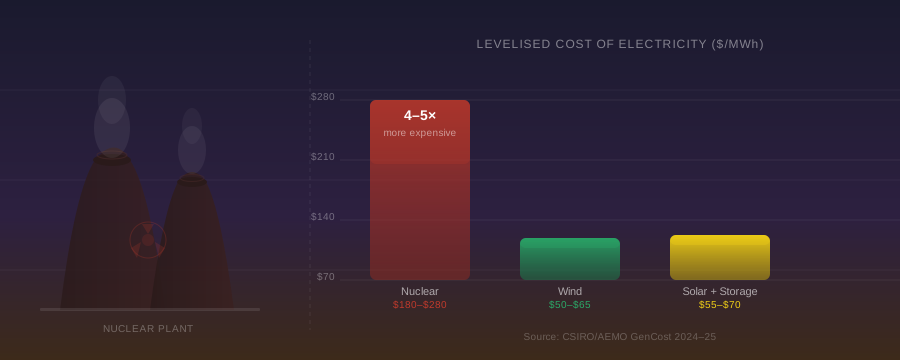
The solutions to climate change are known and increasingly cost-competitive. The challenge is implementation speed. Every year of delay adds to the cumulative concentration of greenhouse gases and locks in more warming.
What Clean Energy Adoption Does
An electric vehicle powered by rooftop solar emits no operational carbon. A home heated by a reverse cycle heat pump running on renewable electricity emits no operational carbon. The electrification pathway — solar, batteries, heat pumps, EVs — is both the most effective and increasingly the most affordable route for Australian households to reduce their climate impact while improving their energy economics.